Episode 1483
Jun 27 2022
SuperTruth® for the UltraBeliever
Are there any real mysteries left? Clearly, we’re not the doe-eyed, innocent public we once were, back when Howdy Doody and Alka Seltzer ruled the popular infotainmosphere. It’s not enough for things to be true anymore. Now they must pass a more rigorous test: the test of believability in the state-of-the-art laboratory of public opinion. And yet somehow there still remain unsolved phenomena to boggle the jaded mind, shake us out of our trances, and remind us never to trust our senses, our reason, our memory, or the evidence. We live in a truly miraculous time, when anything can be true.
But only the best things can be SuperTrue®.
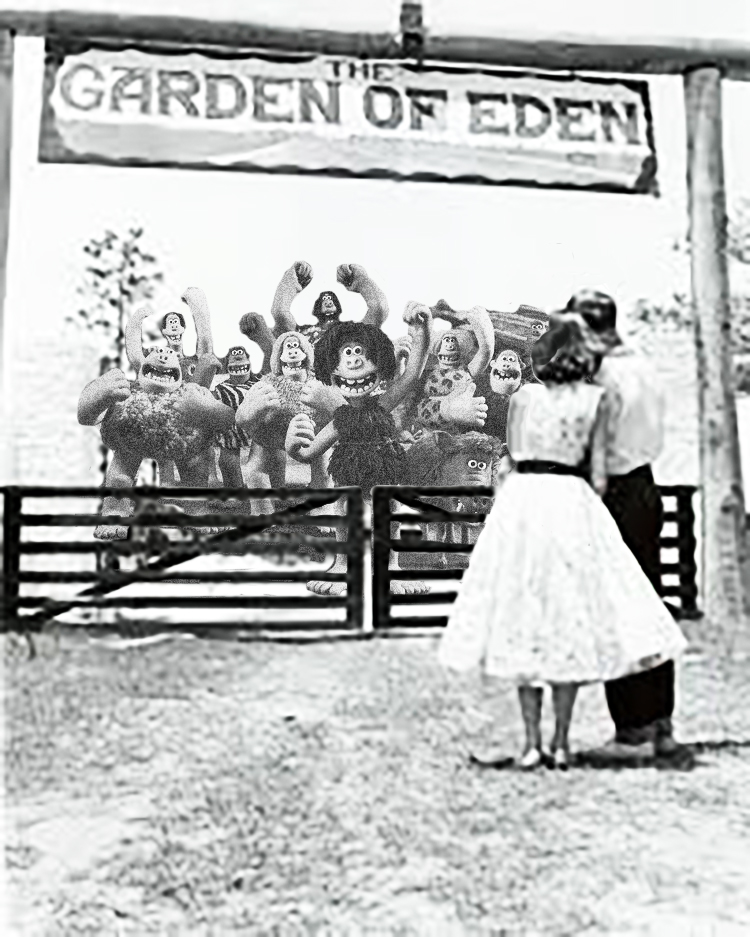
The Barbed Wire of Eden
One sunny Sunday morning, archaeologist, Trudy Braznorkle, working overtime on a dig in the mountains of Afghanistan, found her garden trowel’s tip wedged, immovably, between a rock and hard thing embedded in the Afghan clay. The trowel stuck out of the earth at a thirty-three-and-a-third-degree angle. She put all the weight she could bring to bear upon it by standing on the handle with one foot. The trowel handle bent all the way to the ground before she released it with a “sproy-yoy-yoy-yoing” sound. She tried again. “Sproy-yoy-yoy-yoing!” She did it a few more times because she enjoyed hearing the sound.
Then the handle of the trowel broke off. She tried next with a pry bar and eventually removed the stubborn artifact from the clay. What she saw turned out to be confirmation of a very old, obscure legend.
A book of early apocrypha, The Shawarmas of Enochle, tells of a garden, recognizable as the selfsame Garden of Eden from the Old Testament book of Genesis. The description is reported by an ancestor of Noah (builder of the famous ark), Enochle, who recounts being told by Adam and Eve about the garden soon after they faced eviction from it.
It’s long been held by biblical scholars that Eden was the first gated community. Barbaric Australopithecans and other inferior hominids were denied entry. It may be that these brutes were early failed experiments by God himself. Even hobbits, cute and whimsical though they were, could not pass through Eden’s gate, nor gain ingress by digging a tunnel beneath the hedgerow. Boobytraps bristling with poison-dipped barbs would spring into the face of anyone foolish enough to try to... read more
I don’t know about you, but a little thrill goes through me every time the fates dangle the possibility that one or more Trumps or Trump followers or Trump clones or just all-around fascists might come in for some suffering.
So just imagine my giddy ecstasy watching the opening ceremonies of the January 6 Insurrection Hearings. I know it’s cheap entertainment. I know in the larger scheme it won’t change things for most people harassed by the whims of capital, but you should know I also like movies about giant monsters smashing miniature cities. And porn, I like myself some porn now and then, as a reminder that sex still happens somewhere, although evidence of it in my personal life seems to have been expunged as though from a crime scene cleaned by a brilliant, obsessive-compulsive serial killer.
And let me assure you, I’m done feeling even a twinge of envy that the fascists got so close to staging a coup d’etat by storming the nation’s capitol. I mean, these folks were operating under a delusion that their fat fascist Orange Julius was a rightful… something. Had the left done anything like this it would have at least been for a legitimate reason. The right has been building power over the last half-century by feeding a gullible, misdirected base lie after lie, each more inane and insane than the last.
This is not to say the left hasn’t aided in the project with certain clownish antics, but blaming the clownish faction of the left for the right’s success in peddling conspiracies is like blaming clowns for your uncle’s phobia of creme pies. And that your uncle organized a rabid, armed militia of vigilantes against anyone suspected of potential pie-throwing is, of course, not the responsibility of the hero who put a hateful Anita Bryant in her place back in the day with a well-aimed dessert. Face it, your uncle’s a basic a-hole, and that’s a condition he’s aspired to. He's taken his personal paranoia and whipped it into a mob movement.
Meanwhile, the left is accomplishing the unionization of Starbucks baristas in a growing number of cities, and that’s no small achievement. The labor movement seems to be back on its grassroots feet again, thanks to the Overton Window expanding to allow in general anti-corporate discourse, in part aided by the same crisis of capitalism that is the only root of the... read more